Wednesday, April 12, 2017

Ourense

Piligrims are showing up in different places, walking and on biciycles. This is Easter week holiday and many Spanish piligrims at heart, walk the camino in stages, as their holidays allow them to do it. Also being closer to Santiago, some piligrims walk the last 100 km to recieve the Compostela.

Wow !! I am now 100 km from Santiago !!

From Xunqueira de Ambia to the center of Ourense, there are 26 km.
The moon is full, orange and very bright. Four of us piligrims decide to leave the albergue at 6 am to avoid the extreme heat past noon (unsual weather for this time of the year) and also avoid the traffic, as today's walking has a fair amount of walking on a secondary road. 

The Via de la Plata has very little road walking, which is great. Roads, villages and cities are as much part of the camino as valleys, mountains and narrow trails. Through history and centuries, those piligrims walking paths, became also the trails that have grown to communicate villages, cities and roads.

Walking, as the day was becoming light, I hear the early morning birds and sounds in the path. It is peaceful, beautiful, cool and I wear my toque and gloves, until the trail starts to climb. Walking in Galicia is always up and down, gaining and losing elevation, both equally hard on the feet and knees.

Ourense is situated in the deep valley (130 m elevation) of the river Miño, which gives a climate hotter and drier than in the rest of Galicia. The Romans built a settelment here to take advantage of the multiple hot springs along the banks of the river Miño that flows through the city. There is also a hot spring site in the center of the city, next to the XII century cathedral. The beautiful cathedral is romanesque and early gothic. The original roman bridge is not standing and a newer stone bridge has been built using the original footings.


The albergue in Ourense is on the site of an old Franciscan middle ages convent, high above overlooking the city and many steps to get to it !! it has 20 bunk beds and the stone walls and wooden new ceilings....a beautiful place to rest and fall asleep. The cloister has 76 double columns, 63 arches showing the transition between romanic and gothic architecture.


walking towards the hot spring 


In the afternoon four of us piligrims visit one of the six hot springs public sites along the river. When I arrived there at 5 pm and + 32C, I decide not to stay  as it is too hot for me. 


I returned to the comfortable sheltered albergue where I felt sheltered, protected from the heat and also the constant shock of the life when entering a city after being in the Camino.

Monday, April 10, 2017

Palm Sunday in Albergueria

From Campobecerros to Albergueria was a hard day of 28 km of walking. I left the earliest of any of my camino days, trying to avoid the afternoon extreme heat, when I would be doing the 12 km uphill, that would take me to Albergueria. In this 12 km you gain 500 m of slope elevation. The trail is steep, no shade, very rocky. I did not see any other pilgrims. In two occasions I questioned myself if I was on the right trail. Fortunately I was !!

It took all my strength to walk this 12 km up hill, with very few slope breaks.
The first part of my morning was the opposite. 16 km of downhill, also steep and losing 400 m of slope elevation. My legs were tired. I am looking at my feet, keeping my ankles from turning.
Just as I am writing now, Luis the hospitalero from the albergue in Albergueria, shows up here in Xunqueira de Ambia ( my next albergue) where I am now. To my surprise, he is bringing me my pair of coral earings, that I forgotten this morning next to my bed. Wow !!!
He is so kind to have driven 20 km each way to bring my earrings to me !!! I am in admiration for his gesture.
Yesterday, arriving in the Albergue was fantastic, a great relief.


Albergueria is a very small village on top of a hill. Most houses are stone, incredibly beautiful big stone. It has 27 habitants, mostly old persons and no children.

Luis, came to Albergueria in 2004, fell in love with the village, fixed two stone houses, that are now the albergue and the only bar. He loves music, has set up outside and inside speakers in the front of the albergue, that is across the street, from the bar.
As I arrived, the music of Leonard Cohen is playing. I love Leonard Cohen, know most of his songs and listen to it at home over and over.
My afternoon and evening is spent listening to beautiful music, having Albariño wine, and enjoying the company of five other piligrims and the people that live in the village.

Luis's bar is completely covered with shells, that he gives to each piligrim, who has arrived here. We each write our name, date and country of origin. Incredible to see all of these shells on the walls and ceilings.

Yesterday was Palm Sunday, and at 7 pm there was a Mass in the little stone church in the middle of town. Three of us piligrims attended the Mass and held the branches of bay leaves, that a woman in the village gave me, to be blessed.


I gave my blessed bay leaves branches to Luis, for his bar to use them in the caldo gallego soup, that they eat here almost every day.

Saturday, April 8, 2017

Campobecerros


Rosario, is the owner of the albergue and local bar, she is 64, born here and this 
village has always been her home. She is known in the guidebooks, as an excellent host and cook.

Andrè and I arrived in Campobecerros, within a half an hour from each other. It is 2 pm and the sun is shining very strong. We are the first ones to arrive to this simple, clean albergue.
Behind us, there is a couple from Spain that I met two days ago, a woman from Australia that started the camino in Zamora and a German man that started in Sevilla. He has an incredible determination as this camino is very difficult for him, because he is very big. He weighs around 140 kg, his pack is 15 kg. Always leaves the albergues very early on the morning and last one arriving. We often worry about him and when we coincide in the camino, we slow down and walk beside him to give him strength. I have an incredible respect for him, in walking his first camino.

Rosario serves us the same food that she has cooked for her family, who are sitting next to us in a rectangle table. The head of the table is Marcos a cute 3 yr old, her grandson.
Caldo gallego (gallego soup) steak with potatoes and vegetables. To start, she offers us a taste of their home cured dry jamon and a plate of home made chesse. After the aperitif, I was already full !! The wine is also delicious and my favority type of white wine.
Andrè and I are not able to finish all the food that she has prepared us and it is hard to leave it in the serving tray.
Rosario is sitting next to us, tells me that there is 30 families living in this village and three children in total. "Life is very hard here the climate very extreme, very hot and very cold. The only work is cultivating the fields to feed the animals. The young people have left to the bigger towns or cities and there are only old people left here."
Via de la Plata passing through these very small villages, has given them a little economy, also exposure to the different cultures, nationalities and a vision of the world. 
The locals often ask me many questions and to translate between languages.
The walk today kept us high, there was very few trees around, lots of flowering purple  heathers as far as I could see.


Tomorrow, I will have a 16 km descend to Laza and then a 12 km ascend to Albergaria, where, I will stay for the night.

Friday, April 7, 2017

A Gudinya

The pass yesterday was at 1350 m and even though it was a hard uphill, the climb was gradual and I did well. After the climb, we descended a long ways down to the village of Lubian.
Today's climb was at 1230 m and I found it very hard, exausting. The trail followed a narrow creek bed for 5.5 km and it went straight up and up.I think for me this morning was my hardest climb of this whole camimo.

The ground was muddy, often running water or spongy wet. Lots of rocks, that my feet kept steeping on, in and out. Always in concentration looking at my feet and remembering to breath.
Reaching the pass was a relief and also marking the entrance to the province of Galicia. I remember well the terrain in Galicia, as it goes up and down throughout the way. The sound of water, cow bells, stepping over chesnut husks. This is Galicia !! It often rains, but we are very lucky and it is blue skies and sunny.
I am 200 km from Santiago and have already covered 800 km. At times I found it hard to believe all the ground and history that I have covered, in just one month.
An incredible reminder for me, that if you really want to achieve something, it is generally possible. It is all in the determination and trust in yourself and surroundings.

At the begining, when I thought about walking the Via de la Plata, I questioned myself if I could do it. I questioned my knees, my hips, endurance, mental and physical. I decided that I would try it and hoped that I could do it ! I am very happy to have reached Galicia, be here and so close to Santiago !!

Along the way I have met different peregrinos that have returned home because of injuries, bad blisters, infections...lots of tendonitis.
I am a lucky one, only had 3 or 4 blisters that have healed, two black toenails, that don't hurt and the toes are ok and some pain in my leg shins, that I manage with Ibuprofin, when it really bothers me, that is not when walking but at night when resting.


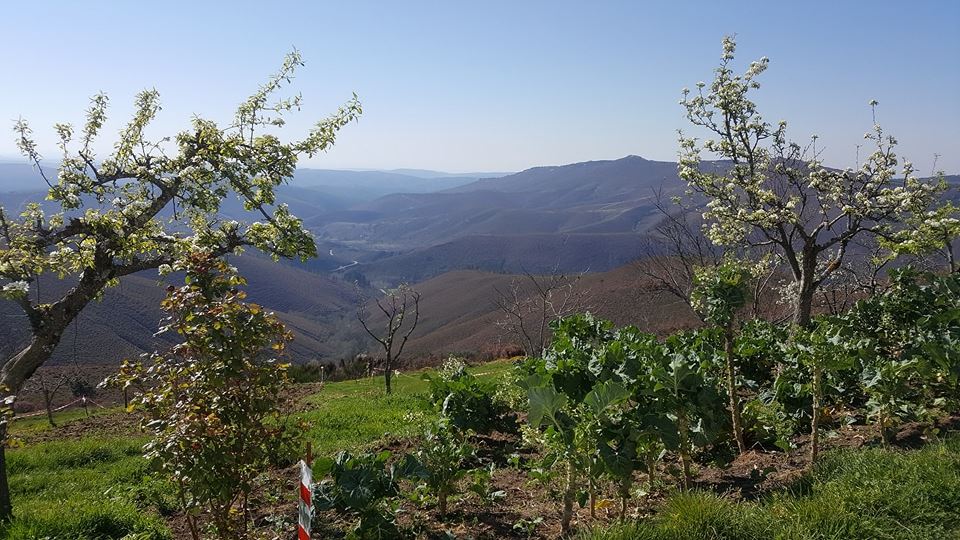
Today's remaining 17 km after the pass, were absolutly beautiful. I walked the ridges, no trees. The grown was covered with purplish flowering heathers, big rocks, bulders and rolling terrain. 
I stopped and rested for more than 30 minutes to eat and admire the beauty of the landscape. I passed three small villages with very friendly people, with the markings of a hard life.


Tonight I am in A Gudinya, just cooked pasta with pesto sauce that three of us piligrims have shared. Every one in the albergue is looking very tired.

Thursday, April 6, 2017

1350m The Pass

During this last week, I could see the mountains between Sanabria and Galicia in the very far distance, with snow in the peaks.
Every day the mountains and huge wind mills, were closer and closer, as I walked.
Today, was the day that the Camino would take me over this pass, at 1350 m

I left Requejo at 8 am after a great café con leche and toast in the village, knowing that it would be a steep, long hot day going over the pass and with high probability of getting lost.
There was a break in the Camino signs and markings, as they are constructing a new AVE line (high speed train line) over this area and the camino markings are gone.
Fortunatelly there is another piligrim that has been walking similar rhythm than I am, from Holland, and today we stayed close to each other. When one of us was wondering where the camino was going, the other would notice something that could help us decide on where to go. We did very well and managed to make our way with very few detours. 
When we arrived at the albergue, everyone else had had difficulties and arrived exausted.
The weather continues yo be very hot during the day, deep blue skies and freezing at night.

Lubian is the last village of the Zamora region and tomorrow we will cross into Galicia.
The houses and terrain are typical of Galicia, always going straight up and steep down. 
You can hear the cow bells from a distance.
I crossed beautiful spring fields and creeks.

Yesterday, I passed Puebla de Sanabria. Puebla is a mediaval village that has a beautiful castle on the top. Just as I entered the village, Andrè, my dutch peregrino friend, appears. We have both already walked 15 km
and we have 10 more to Requejo, our destination tonight.
As we both look at the castle high above, we played a little game and try to guess how many steps there is from the bottom to the top, to reach the castle. My guess 230 steeps, his 300 steeps.
Slowly we climb up the stone large steeps, counting and laughing.
Wow !!! To our surprise there is 235 !! I won a glass of Albariño wine, when we get to Requejo. Albariño is a delicious white Galician wine, that I like very much.
The medieval town around the castle is very well preserved. We wandered through the little streets and admired the timber and stone houses.


An older man is walking down, as slow, as we are walking up. When our steps meet, we all stopped to catch our breath and have a little conversation.
To our surprise he starts reciting a poem. His words are perfect, the intonation and his passion, as he recites, is captivating. His name is Gregirio, born in Sanabria and he tells us that every day he walks around the castle. He recites another poem for us, a poem that he wrote for his wife when he was 21 years old, doing the military service, near Pamplona.

I am in admiration of the beauty of his words and memory. 

Again another gift that the camino has gifted me.

Tuesday, April 4, 2017

Sanabria Way

In Granja de Moruela, the Camino divides in two. You can go north to Astorga and meet the Camino Francés to Santiago or west through Sanabria and Ourense to Santiago.
Nine years ago, I walked Astorga to Santiago. For me there was no doubt that I would take the Camino Sanabres to complete my VDLP.

The landscape has changed again, as I pass through more little villages and the distances between albergues not as long. Many of these small villages don't have a store or coffee shop/restaurant. The houses are mostly made out of beautiful stone and together with the oak beams, have stood this region's extreme weather over the years.
I like people, I often stop and talk to the persons in the villages, to learn about their lives. They all have something in common, as they tell me that in the villages, there are only old persons left.

Tonight I am in Asturianos, a very small village that has a municipal albergue that sleeps six.There are five of us here tonight. During my walking today, I did not see any of my piligrim friends, sometimes it felt lonely but the smiles of the inhabitants that I meet, give me the energy to walk. The lady at the restaurant tells me that there is only one child in this town. A nine year old girl.

He is 94 years old, has lived in this village all his life. It is very hot, the sun is shinning strong, but he is dressed as if it was very cold. He smiles as I pass by and tells me about his donkey. She is a beautiful long hair donkey, 22 years old. Every day he takes her out to collect and bring home firewood. She has a name (that I can't remember). He went to Santiago once and he is very thankful for his health.

She is 95 years old, when I passed her village of 12 inhabitants this morning, she was wearing a faded red housecoat. The wrinkles of her face, disapeared, when looking into her serene smiling eyes. Her husband is sitting by the little stone church with his walking stick on his hand. Every day someone comes from a nearby village, to spend one hour with them and ensure that they are well. She invites me into her house and I drink some water.


Two km's past a town, I see a bus stop shelter, and when I am close, I see two older men and a woman sitting . I stop and I ask them if they are waiting for the bus? They tell me "No, we come here, to see the piligrims walk by".

I dedicate these last days of walking to all these special persons that I meet along the way. They have worked their land so hard, built their homes, raised their children. Have lived in a Spain pre and post civil war. Now, as their lifes come to a completion, their smiling eyes, gestures, hospitality and kind words, have enriched my life.


I am very thankful to them.

Monday, April 3, 2017

Santa Marta

The evening meal Tábara is prepared by the hospitalero and three of us piligrims shared the hospitality of this albergue. When we arrived, one by one, they told us to leave our laundry in a basket and that they will wash it for us and it would be dry and ready in the morning. This albergue follows the authentic traditions and attention to the piligrims. 
They tell us that they are here to serve us.

On different occasions I tried to help prepare the meal, do the dishes or pick up the laundry from the line....they tell me to enjoy the moment, rest my body and mind.
The evening is very pleasant and we shared a conversation in three languages. José Almeida is the hospitalero, poet and writer and I admire many of his books on the shelf.

Walking to Santa Marta was lovely, the weather perfect for walking through these fields of cultivated land and oak trees.

The Romanic church next to the albergue is in the center of town. It has the oldest stone statue of Santiago dating to the X century.
At the spring and autumn equinox only, at eight o'clock in the morning, the sunlight illuminates the figurative capital, that ends at the left column, at the arch of the apse. The sun rays come through the circular carved little window in the center facade of  the apsidal chapel. The capitals are made of limestone, making this capital very light in colour.
 
The capital iluminated by the equinox lighting, shows the figure of an angel representing the soul going to heaven.


Last night I had a wonderful sleep. The room was very warm, shared the room with just one other piligrim who slept very very quietly.
I didn't wake up till past 8 am.